

High School Special Education Teacher, Kathy Grabowski’s Living Environment II class completed a unit called, The Animal Body: An Evolutionary Journey which explores the dissection of a clam, starfish, and shark.
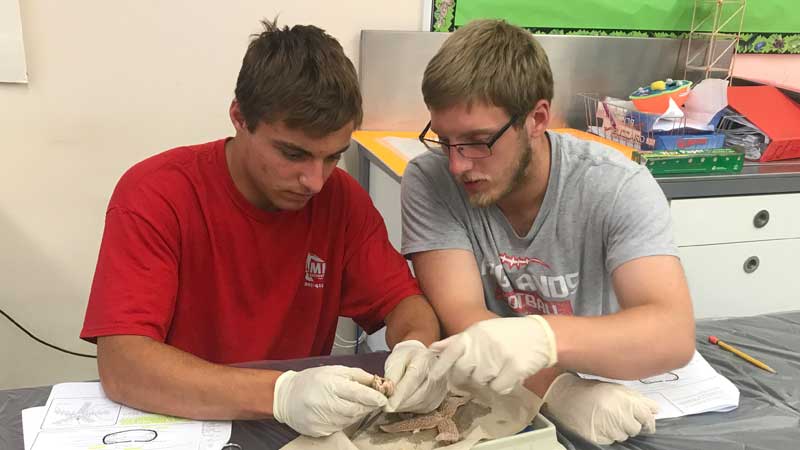
The Clam Dissection Lab is the study of the internal and external anatomy of a bivalve mollusk. Students prepared for the lab by dressing in lab apron and plastic gloves.
We opened the clam and examined the interior features and surfaces. Like all mollusks, a clam has a mantle which surrounds its soft body. We located the muscular foot, which enables the clam to burrow itself in mud or sand, and anterior abductor muscles.
We learned that the rings on the clams outer shell are called growth rings and signify the age of the clam.
The Sea Star Dissection Lab, or more commonly known as the starfish, is an Echinoderm which is a symmetrical animal only found in the sea. Our starfish had five appendages, which we dissected.
The arms of the starfish are called rays which have hundreds of tiny feet on the bottom that help the starfish move. Inside each ray, we located two long digestive glands that help digest food in the stomach.
We then examined the bony plates that make up a starfish skeleton which are called ossicles.
The Shark Dissection Lab we studied both the internal and external anatomy of the shark.
For the external investigation of the lab, we looked at the shark’s fins, gills, and skin. The internal dissection was much more complex. Shark’s have intricate nervous systems and digestive tracts. The shark’s vertebral column made it unique compared to the clam and starfish dissections.
We also looked at the brain and the reproductive system to determine if the shark was male or female.
Our hands-on labs provide immersive learning experiences around science. Our science labs engage students who are tactile or kinesthetic learners. This type of learner thrives when movement is involved. For social learners, the lab allows time for small group conversation that strengthens their content knowledge, communication skills, and confidence. The labs also engage students who are auditory learners that like to discuss the process, and our visual learners gain the opportunity to see what everyone else is creating.